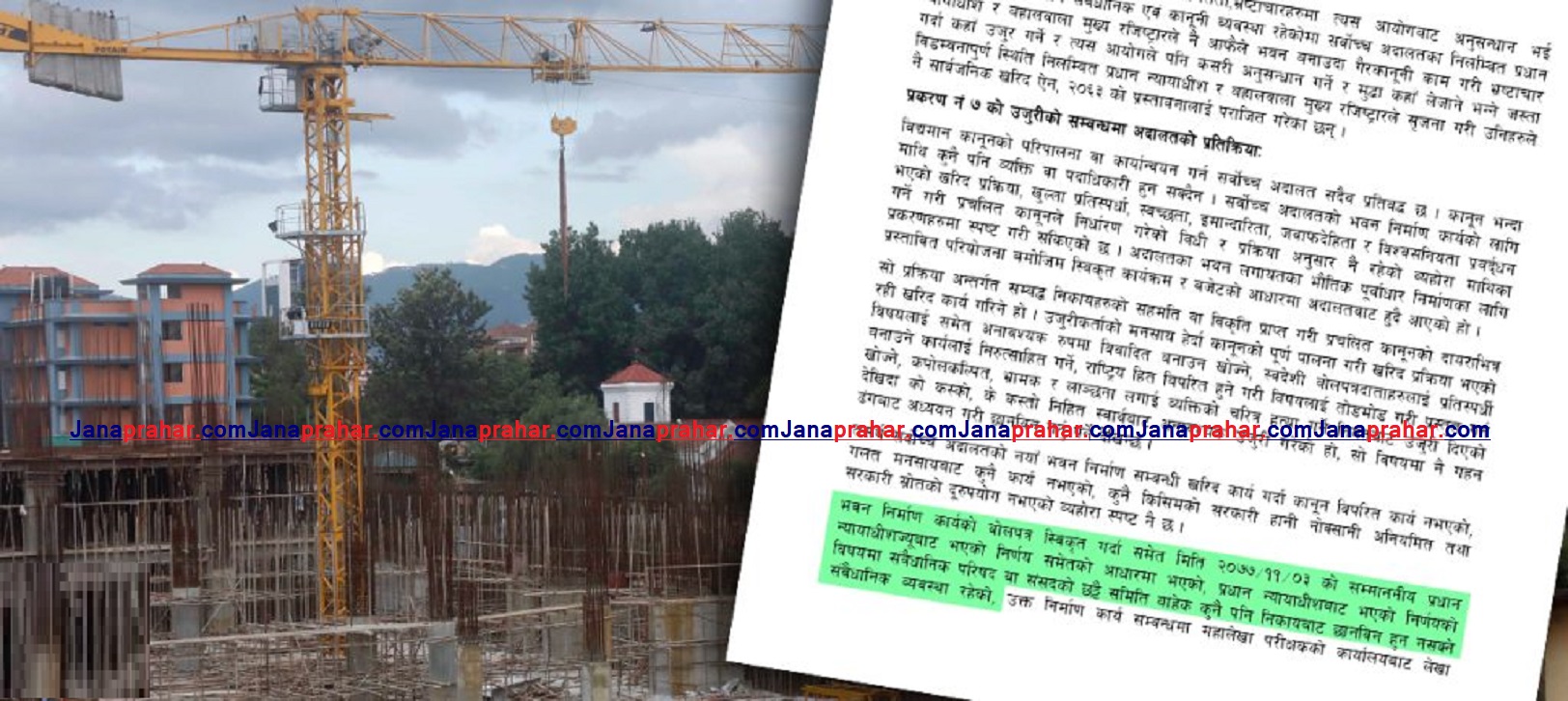
A letter was found by the Supreme Court administration saying that the authority cannot investigate the decision of the Chief Justice and the Chief Registrar.
Kathmandu. It has been found that the Supreme Court administration has written a letter to the Abuse of Authority Investigation Commission stating that there can be no inquiry and investigation into the irregularities during the construction of the building. Last May, the Supreme Court Administration sent a letter claiming that there were no irregularities in the construction of the building.
The letter signed by the Registrar of the Supreme Court, Narayan Panthi, said, “There is a constitutional provision that the decisions made by the Chief Justice cannot be investigated by any body except the Constitutional Council or a special committee of the Parliament.” It is respectfully requested that the complaint given on purpose be kept on file.
After receiving a complaint that there were irregularities in the construction of the Supreme Court building, the Commission for Investigation of Abuse of Authority sent a letter to the Supreme Court on 4th May 2079 and asked for information about it. In response, the Supreme Court administration sent a reply on 16 Baisakh 2079 stating that there was no irregularity.
In the 10-page response received from Jana Prahar from a higher authority, the Supreme Court administration seems to deny the irregularity of the construction of the building. At that time, the Supreme Court had not started an investigation into building construction irregularities. Chief Justice Deepak Kumar Karki also inquired about this after it was revealed that the Supreme Court had sent a letter of irregularity.
The Abuse of Authority Investigation Commission sent 7 questions and asked for information about the construction of the building. The Supreme Court Administration has written answers to only 6 questions. One question is not related to the construction of the building and the answer is not written.
The Supreme Court has also sent 5 types of documents to the authority along with the answer. In which there are other documents related to the tender including the decision made by the then Chief Justice Cholendra Shamsher Jabara on 3 February 2077.
In the letter sent by the Supreme Court administration, it is mentioned that the decision taken by the Chief Justice and the investigation of the proceedings cannot be carried out by the authority. It is stated in the letter, “There is a constitutional provision that no body can investigate the decision made by the Chief Justice except the Constitutional Council or a separate committee of the Parliament.”
Although the Supreme Court has raised questions about the authority’s jurisdiction, it has written an answer to the letter. In the letter, the Office of the Auditor General has audited the construction of the building and claimed that there was no illegal activity (during the construction of the building) in its report.
But in reality, the Accountant General not only pointed out that there were irregularities in the construction of the building, but also recommended that the officials involved should be investigated and action taken. When the Supreme Court sent a letter to the authority, it seems that this practice was hidden.
According to the complaint filed with the authority, during the construction of the building, the drawing, design, etc. of the building was done by appointing a consultant of his own, not from the Urban Development and Building Construction Department.
In the complaint, it was mentioned that this could not be done because international tenders should be issued and the competition should be held. The Supreme Court administration has written a reply that international tenders have not been published based on the nature of the work.
Section 15 of the Public Procurement Act, 2063 stipulates the condition that international tenders should be published. In which, there is a provision to invite international bids if “goods or construction works in accordance with the demand of the public body are not obtained from more than one construction business or supplier within the state of Nepal at a competitive price”.
Authority sources say that looking at the documents on the construction of the Supreme Court building, there is collusion by stopping the competition. Authority sources claim that there was no consensus on the need to call for international tenders on the basis of non-competition.
The consultant appointed by the Supreme Court had prepared a cost estimate of 5.89 billion 38 lakh rupees and the tender was issued accordingly. Only one company (joint venture) was deemed eligible and according to the Supreme Court’s proposal, the contract was awarded for 5.876 billion rupees.
Kalika-Parallel JV got the contract for two crore rupees less than the cost estimate. The Supreme Court awarded the contract to the same company on the grounds that it cannot be called competitive as the price has not decreased by even one percent.
Moreover, since the corruption case against Vikram Pandey, the owner of Kalika Construction, was pending, there was confusion as to whether to include that company or not, in which Chief Justice Cholendra Shamsher Jabara made a firm decision and ordered to include his documents.
The Supreme Court stated that international bidding was not done citing various reasons. According to his claim, there was enough competition when the tenders were first invited. Since Nepali has an original design and is not a special and complex construction, international bids have not been published.
To what extent, the Supreme Court said that if international companies work, they should be paid in foreign currency and because of the impact on Nepal’s foreign exchange reserves, international bidding was not done keeping in mind the national interest. But then there was no problem of foreign exchange reserves. all
According to the High Court, four companies competed in the tender. Although not all of them failed on the basis of ability, the other three proposals were rejected because they did not submit the necessary documents.
The letter sent to the authority by the Supreme Court states that the bidders have succeeded or failed based on the evaluation of the capacity and bases set in the documents.
The complainant had said that even though there were serious irregularities in the construction of the building, they were trying to confuse the investigation process. It was mentioned in the complaint that when the suspended Chief Justice Cholendra Shamsher Jabara and Chief Registrar Lal Bahadur Kunwar committed illegal acts and corruption while building a building, where to complain and how the commission should investigate and where to take the case.
In the letter sent by the Supreme Court to the authority, it is claimed that the complaint is false. It is said in the letter, “During the procurement work related to construction, regularity, frugality, efficiency, effectiveness and propriety have been taken into consideration, there is no truth in the complaint…” The Supreme Administration has termed the complaint to the authority as false, baseless and unnecessary defamation.
The Supreme Court administration has accused the complainant. In the letter, it is alleged that the issue of building construction is being unnecessarily disputed and that it is discouraging the local bidders. He has demanded an investigation on the complainant.
In the letter sent by the Supreme Court, it is stated in the letter sent by the Supreme Court, “Who has filed an unnecessary complaint from whom and what kind of vested interest has been made in the matter of ‘seeming that the complaint has been filed with the intention of assassinating the character of a person by trying to sabotage and present the matter in a way that is contrary to the national interest. It seems that it should be studied and investigated in an intensive manner.