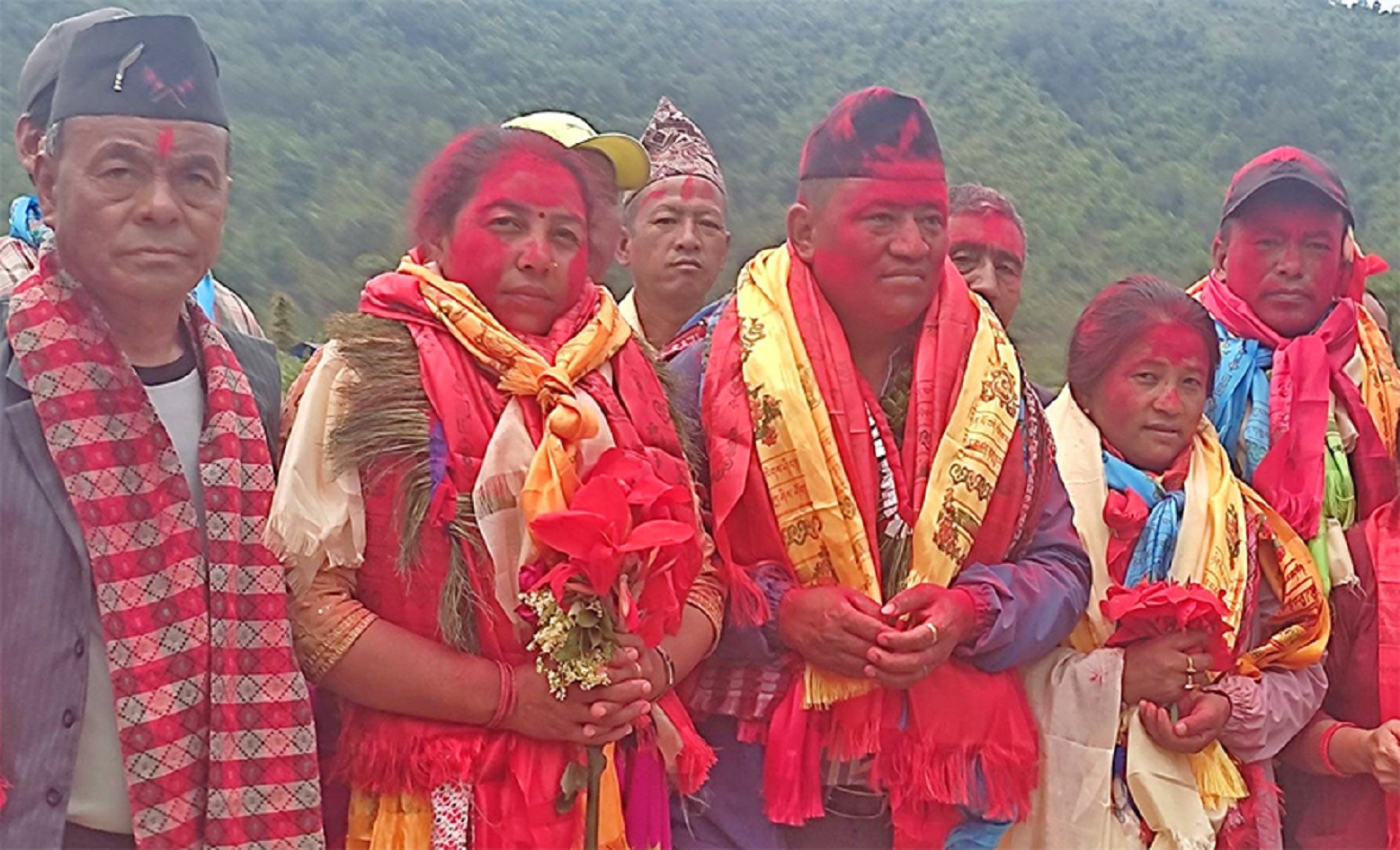
Gorkha. In the previous local level election, the Nepali Congress had won nine out of 11 municipalities in Gorkha. The CPN-Maoist was led by two municipalities in the center.
Five years later, the results of the local elections held on April 12, 2010 showed the exact opposite result. He could not win even in the municipalities which are considered to be under the control of the Congress.
Rajan Raj Pant of the Nepali Congress, who had won the mayoral post of Gorkha Municipality by a margin of 1,534 votes in the last election, lost this time by a margin of 1,856 votes to Krishna Bahadur Rana of the UCPN (Maoist) Center. When Rana was elected with 8,964 votes, the outgoing mayor Pant got only 7,108 votes.
Dr. In Palungtar, the hometown of Baburam Bhattarai, the Nepali Congress, which had won the last election, became the third party this time. In the 2074 election, Deepak Babu Kandel of the Nepali Congress was elected as the mayor after defeating the Maoist centre’s Biswas Chintan by 279 votes. But now Chintan defeated Kandel by a wide margin of 1,075 and was elected mayor.
When Chintan was elected with 6,072 votes, Kandel came third with 4,997 votes. Prem Bahadur Gurung of the nearest rival Janata Samajwadi Party polled 5,717 votes.
In Bhimsen Thapa village municipality, Congress candidate Ishwar Pandey was elected in 2074 BS by a margin of 959 votes. This time, Congress candidate Roshan Gurung lost to UCPN (Maoist) candidate Lok Prasad Banjara by 475 votes.
“The Congress was not flexible even for the alliance because of the arrogance of winning most of the seats,” said a district-level Congress leader. “Over-confidence has increased.
This time in Dharche village, the Nepali Congress suffered a humiliating defeat. In the last election, the Nepali Congress, which had won three wards including the Palika chairperson and vice-chairperson, failed to win the chairperson, vice-chairperson and ward chairperson this time. Sant Bahadur Gurung of the Nepali Congress, who had won the last election with 1,707 votes, lost to Laxman Gurung of the UCPN (Maoist) by a wide margin of 1,825 votes.
Deepak Timilsina of the UCPN (Maoist) defeated Hom Bahadur Rana of the Nepali Congress by 1,671 votes. Rana, who was elected with 6,326 votes, competed with Timilsina and got only 4,655 votes. In the 2074 election, Rana defeated Timilsina of the Maoists by a margin of 281 votes.
In the last election, the Nepali Congress defeated the UCPN (Maoist) Center by 331 votes in Ajirkot Municipality and this time it lost by 498 votes. Deepak Devkota’s rival Congress candidate Govinda Gurung, who won with 3,787 votes, lost with 3,289 votes.
This time, the UCPN (M) also won in Chumanuvri village municipality, which was won by the Nepali Congress in the last election. Dhan Bahadur Gurung of the Nepali Congress, who had won the election by 68 votes in the last election, lost this time to Nima Lama of the UCPN (Maoist) by 313 votes. Lama got 1,624 votes while Gurung got only 1,311.
Not only the municipality but also the wards won by the Congress in the previous election could not be secured this time. The Congress, which had won 45 wards in the 2074 BS election, has shrunk to 37 wards this time. The Maoist center, which won 30 wards, won 43 wards.
The Congress had to lose some wards of Gorkha Municipality, which had won the previous election. In wards 4, 5, 6 and 8, which were won in the 2074 BS election, the Nepali Congress was defeated this time. Out of the total 14 wards, this time the Congress won in 6 wards. In the last election, the Congress had won eight wards.
The effect of internal strife
The party cadres and district level leaders have concluded that the Congress has suffered an unexpected defeat this time due to internal strife. Activists say that inequality in candidate selection and ticket distribution is another reason for losing the election.
A party leader, speaking on condition of anonymity, said, “This is the result of distribution of tickets on the basis of access and money.” He says weak electoral strategy and unpopular candidates are the main reasons for the defeat.
Congress district president Nanda Prasad Neupane, on the other hand, said that there was no cooperation from the Nepali Congress cadres. According to the organization, despite the increase in the number of votes, the result was not positive due to cross-voting.
“We did not get any support from our Congress friends in the wards and municipalities,” he said.
The effect of ‘over confidence’
The Congress, which had won nine constituencies in the previous election, was confident of winning at least seven constituencies this time as well. There is an analysis of some who lost the election due to the same ‘over confidence’.
“The Congress was not flexible even for the alliance because of the arrogance of winning most of the seats,” said a district-level Congress leader. “Over-confidence has increased.
The hassle of ticket distribution
The mayor of Gorkha municipality was defeated by the Congress this time
The main reason is considered. After the Gandaki Pradesh Committee of the Congress decided to give the ticket of mayor to Bishwadev Shrestha, some dissidents not only locked the party office but also assaulted Shrestha.
But later, there is a discussion within the Congress in the district under the pressure of central member Surendra Pandey to give the ticket of mayor to Pant by the state committee. Bitterness within the Congress increased due to their violent behavior after not getting the ticket.
Due to which, the Congress not only lost the city under its control, but also the wards. Independent candidates were elected in the Congress-held ward no. The cadres themselves are angry saying that there is inequality in ticket distribution of other municipalities.
Some effect of the alliance
The alliance may also have some effect on the defeat of the Congress. There was coordination between the Maoist center and the Janata Samajwadi in the post of mayor, deputy mayor of Gorkha municipality and chairman and vice-chairman of Gandaki village.
In Palungtar municipality, there was coordination between JSP and UML. However, the Congress did not form an electoral alliance with any party in all the municipalities. That, too, is expected to have some effect.